July 30, 2026
Back to News
Quick Answer
Most hydraulic cement products reach final set in about 3 to 5 minutes, allowing them to stop active water leaks almost immediately. However, this is only the beginning of the hardening process. After the material sets, cement hydration continues and strength keeps increasing for days and even weeks. Depending on the product and application, a repair may be ready for light service within 24 hours, develop most of its usable strength after about 7 days, and reach its design strength at approximately 28 days.
For the normal 24-hour, 7-day, and 28-day timeline, see our complete guide to how long concrete takes to cure.
The confusion surrounding hydraulic cement cure time comes from the fact that manufacturers often describe different stages of the same process. A product that “sets in 5 minutes” and another that lists a “28-day cure” are not contradicting each other—they are simply referring to different milestones.
Hydraulic Cement Cure Time at a Glance
Hydraulic cement hardens in stages rather than all at once. Understanding these stages makes it much easier to interpret product labels and manufacturer recommendations.
| Stage | Typical Time | What It Means |
|---|---|---|
| Working Time | 1–5 minutes | The material can still be mixed, placed, and shaped. |
| Initial Set | 1–3 minutes | The cement begins losing its plastic consistency and should no longer be reworked. |
| Final Set | 3–5 minutes | The repair becomes firm enough to stop active leaks and maintain its shape. |
| Early Strength Development | 2–24 hours | Hydration continues rapidly and strength increases significantly. |
| Early Service | Around 24 hours | Many repairs can be placed into light service if permitted by the manufacturer. |
| Major Strength Development | About 7 days | Most practical strength has developed under normal curing conditions. |
| Full Cure | About 28 days | The cement reaches or approaches its design mechanical properties. |
Each stage serves a different purpose. Working time determines how long you have to place the material, while set time indicates when the repair becomes rigid enough to perform its immediate function. Cure time, by contrast, describes the ongoing hydration process that gives hydraulic cement its long-term strength and durability.
Understanding the Different Stages
Many people use working time, set time, and cure time interchangeably. They do not. Each describes a different part of the hardening process.
Working Time
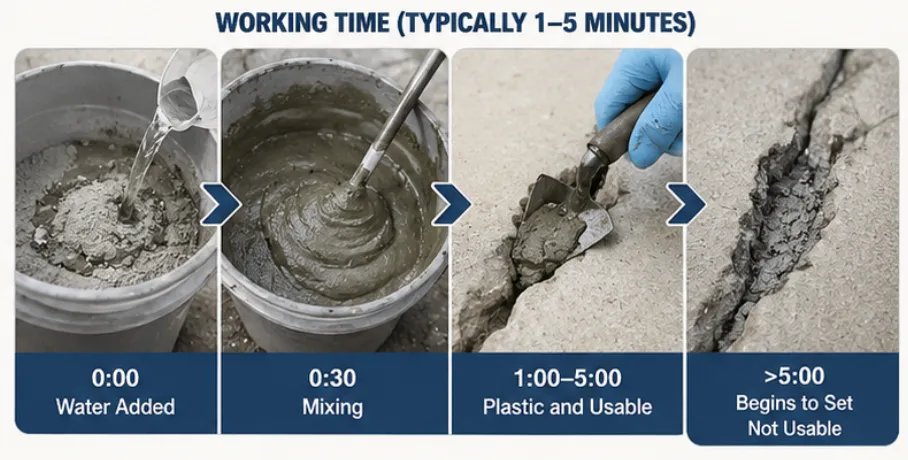
Working time begins as soon as water is added. During this period, hydraulic cement remains plastic enough to be packed into cracks, holes, or joints. Because hydraulic cement reacts very quickly, this window is usually short—typically between one and five minutes.
For this reason, manufacturers consistently recommend mixing only enough material for immediate use. Preparing a large batch may seem more efficient, but part of the material can begin hardening before it is placed, resulting in unnecessary waste and a weaker repair.
Working time is not a measure of strength. Instead, it simply indicates how long the material remains workable before setting begins.
Hydraulic cement remains workable for only a short period after water is added. The timeline shows the typical sequence from mixing to placement before the material begins to set.Initial and Final Set
Once working time ends, the cement rapidly loses its plasticity. This marks the initial set, when the material should no longer be reshaped or retempered with additional water.
Shortly afterward, hydraulic cement reaches its final set. For most products, this occurs within three to five minutes. At this stage, the repair has hardened enough to resist water pressure, maintain its shape, and stop an active leak.
This is the stage highlighted in most product advertisements because it demonstrates how quickly hydraulic cement can solve an emergency repair problem. However, final set should not be confused with full strength. The repair may already feel hard, but the internal hydration reaction is still continuing.
Cure Time
After the cement has set, hydration continues inside the material. Water reacts with cement particles to form new hydration products that gradually increase density and compressive strength.
This process explains why manufacturers often publish strength values at different ages, such as 2 hours, 24 hours, 7 days, and 28 days. These measurements show how the repair develops over time rather than identifying a single “finished” point.
Under normal curing conditions, hydraulic cement continues gaining strength throughout the first week and approaches its design performance after approximately 28 days, much like other Portland cement–based materials.
Why Do Manufacturers List Different Cure Times?
One of the most common sources of confusion is that different manufacturers publish different numbers for what appears to be the same product.
A package may advertise “Stops leaks in 3–5 minutes,” while another product recommends keeping the repair damp for 24 hours or lists 28 days as the full cure time. At first glance, these recommendations appear inconsistent.
In reality, they describe different stages of the same hardening process.
A rapid-setting hydraulic cement is designed to stop water almost immediately, which is why manufacturers emphasize the three-to-five-minute setting time. Technical data sheets, however, often focus on strength development, curing practices, or long-term performance. As a result, they include additional milestones such as 24-hour curing recommendations, 7-day compressive strength, and 28-day design strength.
Rather than contradicting one another, these published values provide a more complete picture of how hydraulic cement performs from the moment it is mixed until it reaches its long-term mechanical properties.
What Affects Hydraulic Cement Cure Time?
Although most hydraulic cement products are designed to set within a few minutes, the actual curing process is influenced by both the product formulation and jobsite conditions. Temperature, water temperature, batch size, and curing moisture can all affect how quickly hydration occurs and how much time is available for placement.
Understanding these factors helps explain why the same product may behave differently from one project to another.
Temperature
Temperature has the greatest influence on both setting time and early strength development.
Warm conditions accelerate hydration, causing hydraulic cement to lose workability and reach final set more quickly. This can be beneficial when an active leak needs to be stopped immediately, but it also shortens the time available to mix and place the material. If the repair is not completed before the cement stiffens, proper bonding and consolidation become more difficult.
Cold weather has the opposite effect. Hydration slows, extending both working time and setting time. While this gives installers slightly more time to complete the repair, strength develops more slowly during the first few hours after placement.
Most manufacturers recommend applying hydraulic cement only when both the air and the repair surface are above 40°F (4°C). Below this temperature, hydration slows significantly, and newly placed repairs should be protected from freezing until adequate strength has developed.
 Concrete can be placed in winter when proper cold-weather construction practices are followed.
Mixing Water
The temperature of the mixing water can also influence setting behavior.
Cold water slightly extends working time and is often recommended during hot weather to slow hydration. Warm water accelerates the reaction and may be useful in cooler conditions where faster setting is desirable.
However, adjusting water temperature should only be used to fine-tune placement time. It cannot compensate for poor construction practices or unsuitable environmental conditions.
 Cold mixing water slightly extends hydraulic cement working time, while warm water accelerates hydration and shortens the setting period.
Batch Size
Hydraulic cement generates heat as hydration begins. The larger the batch, the more heat becomes trapped within the material, causing the reaction to accelerate even further.
For that reason, manufacturers consistently recommend mixing only enough material for immediate use. Preparing several small batches usually produces better results than mixing one large batch that begins hardening before it can be placed.
This is especially important for leak repairs, where even a minute of lost working time can affect the quality of the repair.
Curing Moisture
Unlike setting, curing continues long after the repair has hardened.
Manufacturer recommendations differ because products are designed for different applications. Some hydraulic cement formulations require little or no additional curing, while others recommend keeping the repair damp for several hours or up to 24 hours to support continued hydration.
These differences do not represent conflicting engineering principles. Instead, they reflect variations in product chemistry, repair size, and intended use. Whenever curing instructions are provided in the manufacturer’s Technical Data Sheet (TDS), they should take priority over general recommendations.
When Is Hydraulic Cement Ready for Use?
One of the most common questions is not “When is hydraulic cement fully cured?”, but “When can I safely use the repair?”
The answer depends on the intended application. Stopping an active leak, painting a repaired wall, and anchoring a structural fixture all require different levels of strength.
The following guide summarizes the typical timeline for common applications.
| Application | Typical Time | Notes |
|---|---|---|
| Stop an active leak | 3–5 minutes | The repair has reached final set and can usually resist flowing water. |
| Trim or smooth the repair | 30–60 minutes | The material has hardened enough to be shaped without damaging the repair. |
| Light service | About 24 hours | Many products develop sufficient early strength for normal service, although hydration continues. |
| Painting or coating | About 7 days to full cure | Follow both the hydraulic cement manufacturer’s recommendations and the coating manufacturer’s instructions. |
| Anchoring bolts or fixtures | Varies by product | Waiting time depends on loading conditions, embedment depth, and manufacturer guidance. |
| Full design strength | About 28 days | Under normal curing conditions, hydraulic cement reaches its intended mechanical properties. |
Rather than focusing on a single curing time, it is more useful to think of hydraulic cement as a material that becomes ready for different tasks at different stages. A repair may stop an active leak within minutes, yet still require additional time before it can be painted, loaded, or subjected to its full service conditions.
Common Mistakes When Judging Hydraulic Cement Cure Time
Most hydraulic cement failures are not caused by the product itself. Instead, they result from misunderstanding how the material behaves after mixing. The following mistakes account for many unsuccessful repairs.
Confusing Set Time with Cure Time
The most common misunderstanding is assuming that a repair is fully cured as soon as it becomes hard.
A hydraulic cement repair may stop an active leak within a few minutes because it has reached final set. However, the internal hydration process continues long afterward. Although the repair may already be functional, it is still developing strength and durability.
Recognizing the difference between setting and curing helps avoid unrealistic expectations about how soon a repair can be painted, loaded, or placed into full service.
Mixing Too Much Material
Because hydraulic cement has such a short working time, large batches often begin hardening before placement is complete.
Instead of preparing all the material at once, it is usually better to mix several small batches. This reduces waste, improves placement quality, and provides better control during the repair.
Adding Water After Setting Begins
Hydraulic cement should never be retempered once it starts to stiffen.
Adding water after initial set does not restore the original workability. Instead, it disrupts the developing hydration structure, reducing strength and increasing the risk of cracking or poor durability.
If a batch begins to harden before it can be used, it should be discarded and replaced with freshly mixed material.
Ignoring Jobsite Conditions
Hydraulic cement may behave very differently under hot, cold, wet, or dry conditions.
Warm weather shortens working time, while cold weather delays strength development. Likewise, substrate temperature, repair size, and curing conditions all influence the final result. Following the manufacturer’s instructions while considering actual field conditions usually produces more reliable repairs than relying on published setting times alone.
Conclusion
Hydraulic cement does not cure all at once. Instead, it passes through a series of distinct stages, beginning with a short working period, followed by rapid setting, continued hydration, and gradual strength development.
Understanding these stages makes manufacturer recommendations much easier to interpret. A product advertised as “setting in 3–5 minutes” is describing how quickly it can stop an active leak, while recommendations for 24-hour curing or 28-day strength refer to later stages of the same hydration process.
For practical applications, the most important question is not “How long does hydraulic cement take to cure?” but “What does the repair need to do next?” A leak repair, a painted surface, and a structural anchor each require different levels of strength before they can be placed into service.
By following the manufacturer’s instructions, considering site conditions, and understanding the difference between working time, setting time, and curing time, users can achieve more reliable repairs and avoid many of the problems associated with premature loading or incorrect application.
Frequently Asked Questions
Does hydraulic cement fully cure in 5 minutes?
No. Most products reach final set in about three to five minutes, but hydration continues long after the material has hardened. Strength continues to increase during the following days and weeks.
Can hydraulic cement cure underwater?
Yes. Hydraulic cement is specifically designed to harden in the presence of water and is widely used to stop active leaks in foundations, tunnels, tanks, and other wet environments.
When can hydraulic cement be painted?
Painting recommendations vary between manufacturers. Some products allow coating after approximately seven days, while others recommend waiting until full cure. The requirements of the coating system should also be considered before painting.
Does cold weather affect curing?
Yes. Lower temperatures slow hydration, extending both setting time and strength development. Newly placed repairs should be protected from freezing until adequate strength has developed.
Why do different manufacturers list different cure times?
Most manufacturers are describing different stages of the hardening process rather than conflicting performance. Some emphasize rapid leak stopping, while others focus on curing recommendations or long-term strength development.