Does Superplasticizer Increase Compressive Strength?
Concrete compressive strength improvement with superplasticizers depends on optimized water reduction, correct dosage, cement compatibility, proper mix design, and sufficient curing conditions.
Quick Answer
Yes — superplasticizers can increase concrete compressive strength, primarily by enabling a lower water–cement ratio without sacrificing workability.
The strength gain is indirect rather than coming from the admixture itself.
Superplasticizers typically improve compressive strength through:
Water reduction— modern PCE systems can reduce water demand by approximately 20–40% while maintaining target consistency.
Improved cement particle dispersion— electrostatic repulsion and steric hindrance mechanisms increase effective cement hydration and reduce particle flocculation.
Lower porosity and denser microstructure— lower water content generally produces fewer capillary pores and a more compact cement matrix. In reported studies, superplasticized systems showed ~15% lower porosity together with ~18% higher 28-day compressive strength versus reference mixes in naphthalene-based concrete systems.
Higher hardened strength under optimized conditions— experimental studies on PCE-modified cementitious systems reported compressive strength increases ranging from ~25% at w/c = 0.35 to up to 2.4× strength gain in controlled laboratory formulations, accompanied by reduced permeability and refined pore structure
Does Superplasticizer Increase Compressive Strength? PCE Effects on Concrete Performance
However, compressive strength improvement is not automatic. Actual results depend on:
dosage optimization
cement compatibility
mix design
curing conditions.
Why Superplasticizer Can Increase Compressive Strength
1. Lower Water–Cement Ratio
The primary reason superplasticizers can increase compressive strength is their ability to reduce water demand while maintaining workability.
Without a superplasticizer, achieving a higher slump typically requires additional mixing water.
Excess water promotes capillary pore formation in hardened concrete, resulting in a weaker cement matrix and lower compressive strength.
PCE reduces water demand while maintaining concrete workability and flowability.
Superplasticizers change this relationship.
By dispersing cement particles more efficiently, they allow concrete to reach the same consistency at a lower water–cement ratio. Modern high-range water reducers can commonly achieve ~12–30% water reduction, while optimized PCE systems may reach 20–40%, depending on mix design and cement compatibility.
Lower W/C ratios generally produce:
reduced capillary porosity
denser hardened microstructure
improved compressive strength.
Experimental studies consistently support this mechanism.
In controlled systems, superplasticizer incorporation has been associated with ~18–25% higher compressive strength, reduced pore volume, and improved matrix densification under comparable workability conditions.
2. Better Cement Particle Dispersion
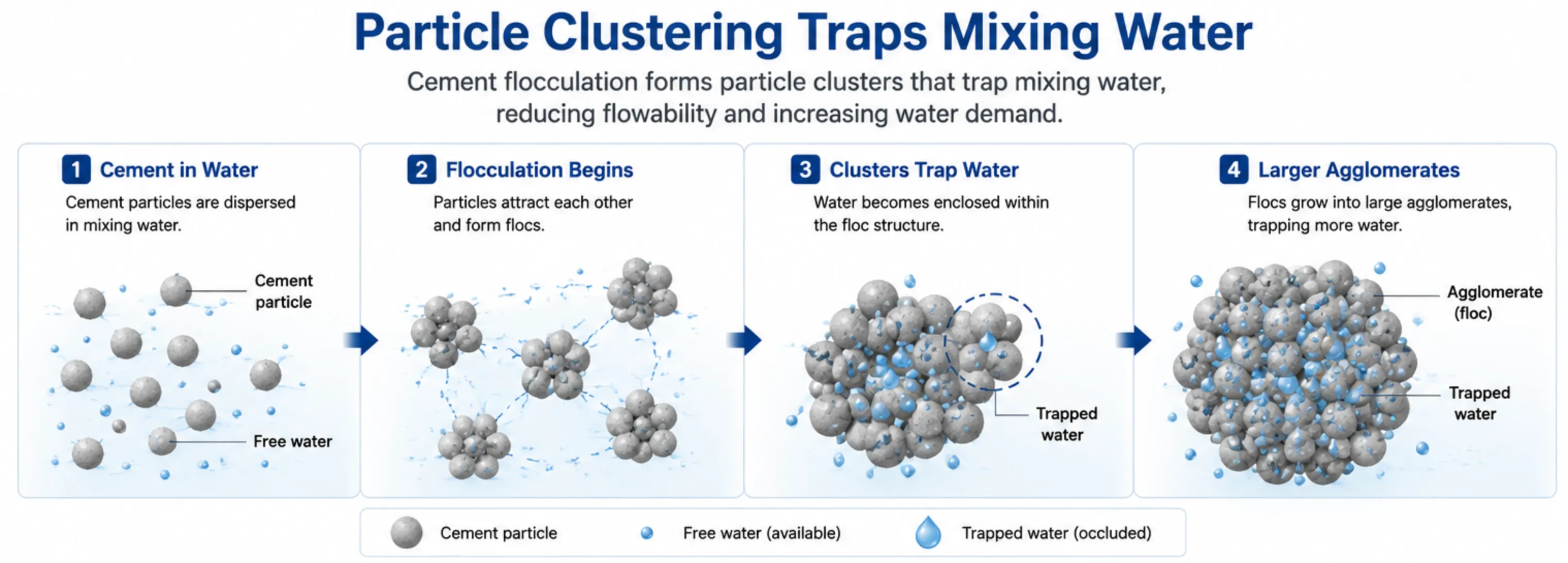
Cement particles naturally form flocculated clusters in water, trapping part of the mixing water inside particle agglomerates and limiting effective hydration.
When cement particles form flocculated clusters, part of the mixing water becomes trapped inside the particle network. This trapped water reduces flowability, increases paste viscosity, and raises the water demand required for workable concrete.
Superplasticizers break up these clusters through:
electrostatic repulsion— commonly associated with SNF and SMF systems
Traditional SNF/SMF superplasticizers mainly rely on electrostatic repulsion, while modern PCE superplasticizers combine electrostatic effects with steric hindrance to achieve stronger dispersion, lower dosage, and better slump retention in concrete.
This dispersion releases trapped water and increases the exposed surface area of cement grains available for hydration.
The result is typically:
improved hydration efficiency
more uniform cement paste structure
lower internal defects and pore connectivity
stronger strength development potential.
Microstructural studies on PCE-modified cementitious systems have reported higher hydration product formation, lower porosity, and denser matrices compared with reference mixes, supporting the link between particle dispersion and compressive strength development.
Want to know more about the difference between SNF and PCE? You can read
A lower water requirement usually produces a denser hardened concrete matrix.
When less mixing water is used, fewer capillary voids remain after hydration, leading to:
lower total pore volume
reduced capillary pore formation
refined pore size distribution
denser microstructure.
These changes are strongly linked to compressive strength development because pore structure directly affects load transfer within hardened cement paste.
Experimental studies consistently report this relationship. In PCE-modified cementitious systems, superplasticizer incorporation reduced total porosity from 24.4% to 16.4% (≈32% reduction), decreased critical pore size, and produced a noticeably denser microstructure with fewer pores and fractures under SEM observation. The same systems also showed up to 2.4× higher compressive strength together with significantly lower permeability (Cavusoglu, Minerals, 2024).
This reduction in porosity and pore connectivity is one of the main reasons superplasticized concrete often exhibits improved long-term compressive strength and durability.
Reduced water demand helps create a lower-porosity concrete structure with higher density, fewer voids, and improved strength performance.
Does Superplasticizer Always Increase Concrete Strength? (When Strength Gains May Be Limited)
Not necessarily.
Superplasticizer does not automatically increase compressive strength. The benefit is conditional and system-dependent.
Strength improvement is most likely when the following conditions are met:
Water content is actually reduced—simply adding a superplasticizer without lowering mixing water may improve slump but deliver little strength benefit.
Dosage is optimized— insufficient dosage may not achieve effective dispersion, while excessive dosage can increase segregation, retardation, or air entrainment. Experimental studies commonly report dosage-dependent strength behavior, with optimized ranges outperforming both underdosed and overdosed mixes.
Cement compatibility is adequate— admixture performance varies with cement chemistry, alkali content, sulfate balance, and supplementary cementitious materials (SCMs).
Mix design is properly optimized— water reduction, binder content, aggregate grading, and admixture interaction must work together.
Curing is sufficient— hydration development and pore refinement depend strongly on curing temperature, moisture availability, and curing duration.
In practice, superplasticizers often improve workability first.
Compressive strength increases only when the improved flowability is translated into a lower W/C ratio, better hydration efficiency, and a denser hardened structure.
Concrete compressive strength improvement with superplasticizers depends on optimized water reduction, correct dosage, cement compatibility, proper mix design, and sufficient curing conditions.
Can Too Much Superplasticizer Reduce Compressive Strength?
Yes. Excessive superplasticizer dosage can reduce compressive strength under certain conditions.
While proper dosing often improves water reduction and particle dispersion, overdosing may destabilize the concrete system and negatively affect hardened performance.
Potential problems include:
Segregation— excessive fluidity may cause coarse aggregate separation and non-uniform concrete structure.
Delayed setting— some systems may experience slower hydration kinetics or extended setting times at high dosage levels.
Excessive air content— unintended air entrainment can reduce hardened density and lower compressive strength.
Bleeding— unstable water distribution may weaken the cement matrix and increase local porosity.
Unstable rheology— overly sensitive slump behavior or loss of mix stability can impair placement and compaction quality.
Excessive superplasticizer dosage can negatively affect concrete performance by causing segregation, delayed setting, bleeding, unstable rheology, and unintended air entrainment.
Experimental studies frequently report dosage-dependent strength behavior, where an optimized dosage range outperforms both underdosed and overdosed mixtures. For example, a study on fiber-reinforced cementitious systems found that 1% superplasticizer dosage produced the best overall mechanical performance, while higher dosage did not continue improving results across all properties.
In extreme cases, these effects may offset the benefits of water reduction and dispersion, limiting or even reducing compressive strength development.
For this reason, superplasticizer dosage should normally be established through:
manufacturer recommendations
compatibility testing
laboratory trial mixes
target slump and strength verification.
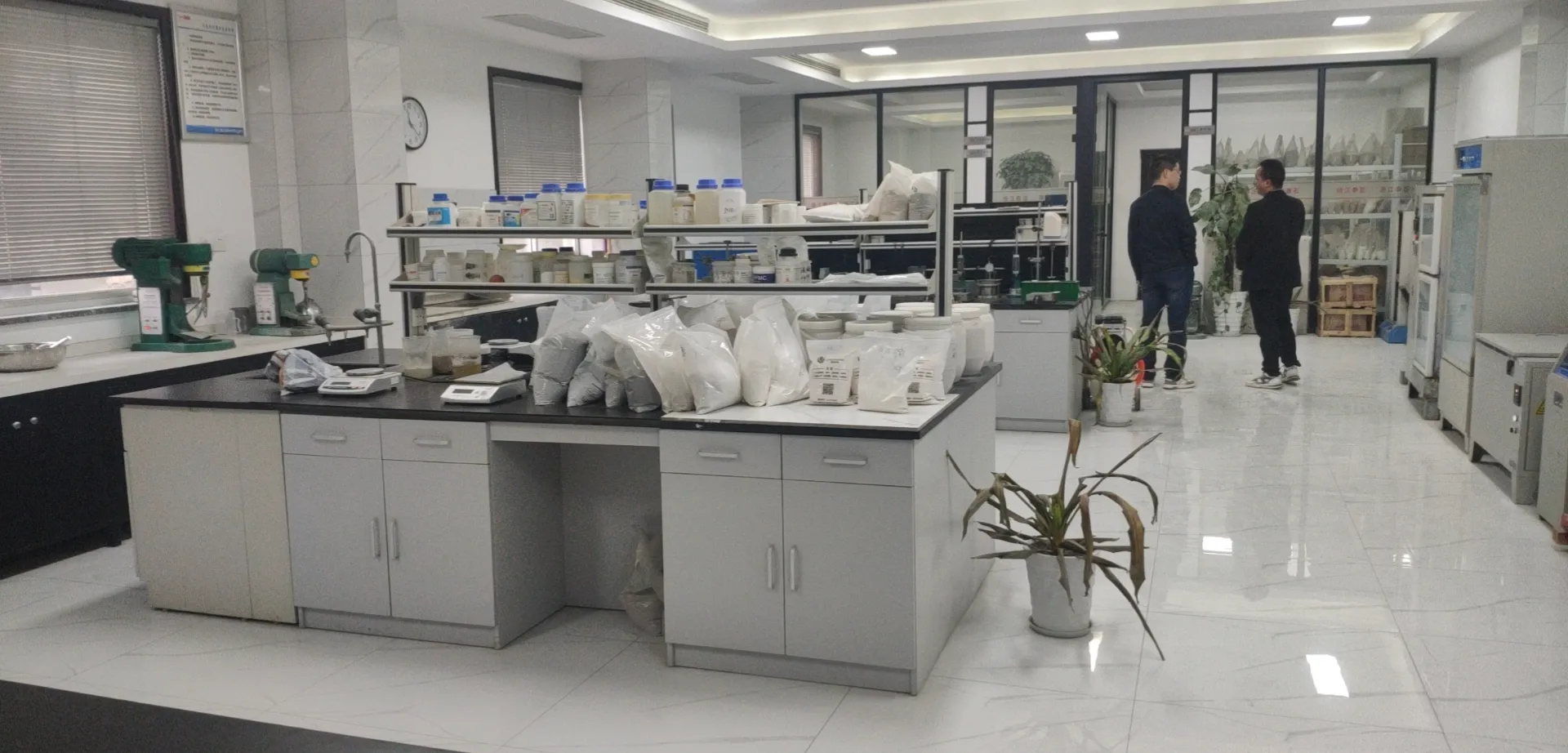
Laboratory measurement of cementitious material flow spread and workability performance.Want to know more about the Common Problems of Polycarboxylate Water Reducer in Concret, you can readCommon Problems of Polycarboxylate Water Reducer in Concrete
Does PCE Increase Compressive Strength More Than Traditional Superplasticizers?
Close-up view of KH-206 liquid superplasticizer sample in laboratory beaker
Often, yes — but performance depends on the concrete system and test conditions.
higher water reduction efficiency— commonly reaching 20–40% water reduction under optimized conditions
stronger particle dispersion through combined electrostatic repulsion and steric hindrance mechanisms
improved slump retention, helping maintain workability without additional water
lower effective dosagein many applications.
These characteristics often support lower W/C ratios, reduced porosity, and denser hardened microstructures, which are closely linked to compressive strength development.
Traditional SNF and SMF superplasticizers can also substantially improve strength performance.
SNF systems remain widely used in ready-mix and high-strength concrete, while SMF systems are commonly selected for precast and early-strength applications.
However, comparative performance varies with:
cement chemistry
sulfate balance
SCM content (fly ash, slag, silica fume)
target slump and curing conditions.
In practice,
The best-performing system is usually determined by compatibility testing and trial mixes rather than chemistry alone.
Does superplasticizer directly increase compressive strength?
Not directly. Superplasticizers do not “add strength” to concrete themselves. Strength gains usually result from lower water–cement ratios, improved cement particle dispersion, and reduced porosity, which together create a denser hardened matrix.
How much compressive strength can superplasticizer increase?
Results vary with dosage, mix design, cement chemistry, and curing conditions.
Under optimized conditions, reported studies have shown ~18–25% higher compressive strength, while some controlled cementitious systems have achieved larger improvements through aggressive water reduction and pore refinement.
Can superplasticizer increase 28-day strength?
Often yes.
Many superplasticized systems demonstrate improved 28-day compressive strength because lower W/C ratios and improved dispersion generally promote reduced porosity, denser microstructure, and more efficient hydration development.
Does PCE increase compressive strength?
Often yes — especially in low-W/C and high-performance concrete systems.
Modern polycarboxylate ether (PCE) superplasticizers typically provide stronger water reduction, improved particle dispersion, and better slump retention, supporting higher compressive strength potential compared with many traditional systems.
Conclusion
Superplasticizers can increase compressive strength — but usually through water reduction, improved particle dispersion, and microstructure refinement, rather than by directly increasing concrete strength.
Actual performance remains system-dependent. Proper dosage optimization, cement compatibility evaluation, mix design control, and curing practice are essential for achieving reliable strength development.
Need PCE Solutions for Strength-Driven Concrete Design?
Whether your application involves high-strength concrete, precast production, SCC, pumped concrete, or low-W/C mix design, selecting the right superplasticizer system matters.